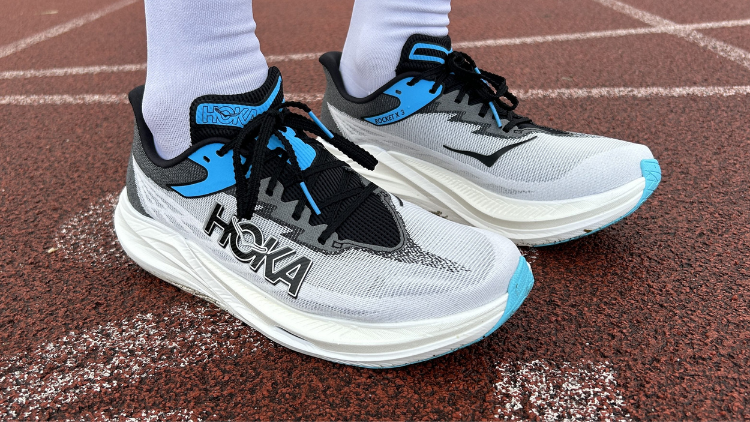
The running world has been buzzing since Hoka unveiled their latest supershoe contender. At $250, the Rocket X 3 strikes a sweet spot between premium performance and relative affordability in today’s high-end racing market. I recently got my hands on a pair through Zappos and was immediately struck by how Hoka has refined their racing formula without abandoning what made previous models successful.
Technical Specifications and Construction
Launch Timing and Pricing Strategy
The Hoka Rocket X 3 hits the market in mid-2025, positioned as a competitive option in the carbon-plated racer category. At $250, the price point remains consistent with its predecessor while offering a more accessible alternative to Hoka’s premium Cielo X1 2.0 model. This strategic pricing maintains the Rocket X line’s reputation for delivering elite performance without the top-tier price tag of some competitors.
Weight and Stack Profile
Weighing between 7.3-7.7 ounces (207g), the Rocket X 3 maintains a lightweight profile essential for race day performance. The substantial stack height—40mm at the heel and 33mm at the forefoot—creates a 7mm drop that balances propulsion with stability. This configuration places it firmly in the modern supershoe category while keeping weight relatively controlled.
Upper Design and Comfort Features
Breathable Construction
The single-layer warp-knit mesh upper prioritizes ventilation during high-intensity efforts. This technical fabric allows consistent airflow while maintaining structural integrity, preventing the foot from overheating during prolonged race efforts or hot-weather competitions.
Strategic Comfort Elements
Hoka engineers have incorporated a softly padded collar that provides just enough cushioning to prevent irritation without adding unnecessary bulk. The non-gusseted tongue design facilitates easy entry and adjustment while keeping the midfoot securely wrapped during aggressive cornering and pace changes.
Performance-Oriented Fit
The upper’s design philosophy eliminates superfluous overlays, focusing instead on creating a streamlined profile that reduces potential friction points. This approach yields a performance-oriented fit that accommodates various foot shapes while maintaining the secure hold essential for maintaining confidence at race pace.
Revolutionary Midsole Technology
Dual-Density Foam Configuration
The Rocket X 3 utilizes a sophisticated dual-density PEBA foam arrangement surrounding a full-length carbon fiber plate. This construction creates targeted responsiveness throughout the gait cycle, with different zones of the midsole providing optimal cushioning or energy return depending on the running phase.
Carbon Plate Innovation
The full-length carbon fiber plate features lateral winglets—an engineering advancement that significantly enhances lateral stability without compromising the forward propulsion that carbon plates are known for. This design element addresses a common criticism of early supershoe models that sometimes felt unstable during cornering or on uneven surfaces.
Proprietary Stability Systems
Hoka’s Active Foot Frame™ technology cradles the foot rather than simply sitting on top of the midsole, creating a more natural foot position during the running cycle. Additionally, the J-Frame™ support system provides neutral runners with subtle guidance without overcorrection, making the shoe accessible to a wider range of biomechanical profiles.
Outsole Grip and Durability Considerations
Traction Engineering
The outsole utilizes a sticky rubber compound strategically placed in high-wear zones to maximize grip where most needed. This focused approach to rubber placement delivers exceptional traction on both dry and wet road surfaces without adding unnecessary weight to the racing platform.
Durability Assessment
User feedback indicates mixed durability results. While the rubber coverage offers good grip during races, the reduced coverage compared to training models may affect longevity. Some reports suggest potential for early midsole gouging in high-stress areas, particularly for runners with specific gait patterns.
Surface Specialization
The outsole configuration performs particularly well on road surfaces and track environments—its intended racing habitats. The balance of grip and weight makes it especially suitable for road races ranging from 5K to marathon distances where consistent traction is crucial for maintaining goal pace.
Performance Across Racing Distances
Versatile Race Application
The Rocket X 3 demonstrates remarkable versatility across race distances, performing admirably from 5K efforts through full marathon races. The balanced cushioning-to-responsiveness ratio proves suitable for the varied demands of different racing scenarios, making it a potential “one-shoe quiver” for competitive runners.
Tempo and Threshold Excellence
During tempo efforts and threshold training, the shoe delivers a particularly responsive feel. The carbon plate and dual-density foam work in concert to provide energy return when pushing the pace, while the stability features maintain form integrity even as fatigue sets in.
Downhill and Late-Race Performance
Downhill sections showcase the shoe’s controlled yet energetic transitions, allowing runners to capitalize on gravitational assistance without sacrificing control. This characteristic becomes especially valuable during the later miles of longer races when form typically deteriorates.
Recovery Pace Limitations
The shoe performs slightly less impressively at recovery paces compared to dedicated training models. Its racing-oriented design means runners might prefer alternating with more forgiving options for easy days and recovery runs.
How It Compares to Competitor Racing Shoes
Stability Advantage
The Rocket X 3 provides a more stable platform than the Hoka Cielo X1 2.0 while maintaining comparable speed potential. This stability advantage becomes particularly apparent during technical courses with multiple turns or when fatigue affects form in the latter stages of longer races.
Safety and Predictability
Compared to the Adidas Adios Pro series or the Puma Fast-R, the Rocket X 3 delivers a safer, more predictable ride without sacrificing responsiveness. This characteristic makes it appealing to runners who have found other supershoes too unstable or unpredictable under racing conditions.
Fit Considerations
One potential limitation is the relatively narrow toe box compared to some competitors. While this creates a locked-in racing fit appreciated by many, it may limit appeal for wider-footed runners who require more volume in the forefoot area.
Weight-Durability Balance
Though slightly heavier than some elite racing options, the Rocket X 3 compensates with enhanced durability. This tradeoff makes it potentially more economical for runners who want to use their racing shoes for key workouts as well as competitions, extending the practical lifespan of the investment.
The Verdict: Who Should Buy the Rocket X 3
The Hoka Rocket X 3 available at Zappos represents a significant evolution in racing footwear. While not the absolute lightest option on the market, it delivers a balanced combination of stability, responsiveness, and versatility that will appeal to a wide range of performance-oriented runners. The $250 price point, while substantial, reflects the advanced technology packed into this model. For runners seeking a carbon-plated racing shoe that performs consistently across various distances and conditions, the Rocket X 3 deserves serious consideration. Its blend of innovative features and predictable performance makes it an excellent choice for both race day and quality training sessions.
Leave a Reply