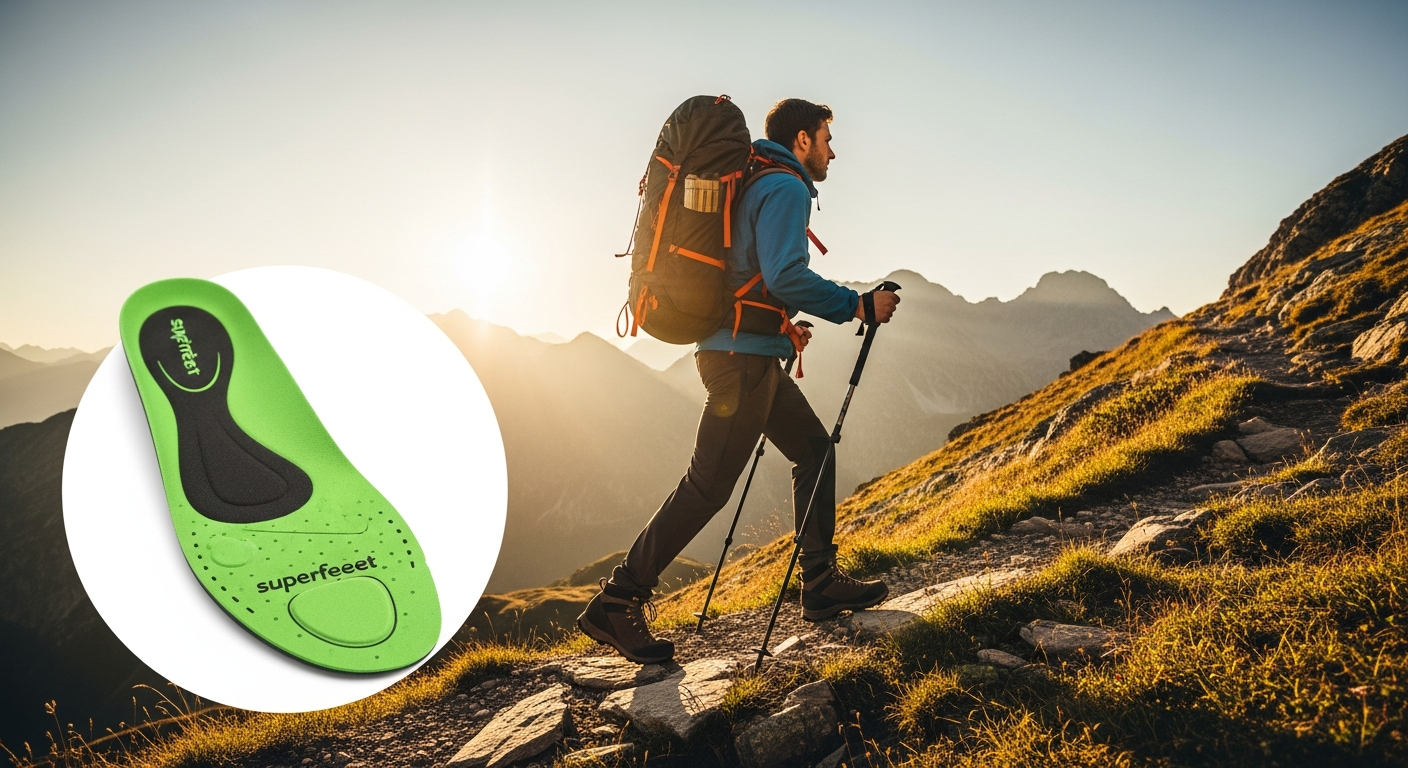
Over 70% of hikers experience foot pain within the first few miles of a trail, yet most never consider that their insoles might be the culprit. Whether you're tackling a weekend summit or logging serious backcountry miles, your feet absorb tremendous impact—and without proper support, even the best hiking boots can't save you from blisters, arch collapse, and the dreaded post-hike soreness that keeps you off the trails for days.
Superfeet Green All-Purpose Support Insoles have become the go-to choice for outdoor adventurers who refuse to compromise on comfort or performance. Originally designed as a premium, non-custom orthotic solution, these insoles combine biomechanical engineering with real-world durability—all at a fraction of what custom orthotics cost. Their reputation for alleviating plantar fasciitis, stabilizing high arches, and reducing cascading pain throughout the kinetic chain has made them a staple in hiking communities worldwide.
Discover how Superfeet Green insoles can transform your hiking experience today.
What Makes Superfeet Green Insoles Ideal for Trail Athletes
The engineering behind Superfeet Green insoles specifically targets the demands of hiking and trail work. A deep, wide heel cup design provides exceptional cradling and natural shock absorption on uneven terrain, preventing the lateral foot roll that destabilizes your gait on rocky passages. The high-arch support system is specifically engineered to stabilize your feet during steep descents and technical footwork where precision matters most.
The firm stabilizer cap acts as the foundational structure, preventing overpronation and excessive foot roll that accumulates over miles of downhill hiking. This isn't passive support—it's active biomechanical correction that keeps your foot aligned from heel strike to toe-off, every single step.
The high-density foam layer maintains its cushioning properties even after hundreds of miles of hiking, resisting the compression that weakens cheaper alternatives. An organic odor-control coating combats bacterial growth during multi-day backcountry trips, keeping your boots fresher during extended adventures. Finally, the trim-to-fit customization allows precise adjustment to your hiking boot's specific dimensions, ensuring maximum contact and support.
How Arch Support Transforms Your Hiking Performance
Strong arch support does far more than eliminate immediate foot discomfort. It reduces stress distribution across your feet, ankles, knees, and lower back—critical considerations for long-distance trail work where cumulative stress compounds over hours. Your feet carry roughly 1.5 times your body weight on flat terrain and significantly more on descents, making proper load distribution essential for injury prevention.
These insoles prevent the foot collapse that occurs during fatigue, maintaining proper alignment mile after mile when your muscles are depleted and alignment naturally degrades. They stabilize pronation patterns that contribute to shin splints, knee pain, and hip discomfort on downhill sections where overpronation is most pronounced.
The arch support enhances proprioception and balance on rocky, uneven terrain where foot stability directly impacts safety. You'll notice improved confidence navigating technical sections because your feet have a stable foundation. Decreasing overall muscular fatigue by optimizing biomechanical efficiency throughout your lower kinetic chain means you can hike stronger in the final miles. For those battling plantar fasciitis, the support directly addresses this condition by stabilizing the foot and preventing the inflammatory cycle that keeps hikers sidelined for weeks.
Breaking In Your Superfeet Greens: The Adjustment Timeline
Expect an initial rigidity period during Days 1-3 where the firm feel requires gradual acclimation rather than immediate comfort. This isn't a sign of poor quality—it's the nature of supportive orthotics. Your feet have likely adapted to minimal support, so structured alignment feels foreign initially.
The transition phase spans Days 4-10 as your feet adapt to the structured support and muscles strengthen. You'll notice the firmness becoming less jarring and more purposeful. By Weeks 2-4, full integration occurs as the insoles begin molding to your foot's unique contours while maintaining their support structure. This is when most hikers experience breakthrough comfort moments.
Accelerate break-in by starting with shorter day hikes before committing to multi-day treks. Build tolerance by increasing trail difficulty and distance incrementally rather than jumping straight into challenging terrain. Ensure your hiking boots have removable liners to accommodate the high-volume profile—this is non-negotiable for optimal fit. Testing your Superfeet Greens around home for 2-3 days before serious trail miles reveals fit issues before they become problems on the mountain.
Real-World Durability and Longevity on the Trail
A 12-month or 500-mile lifespan provides excellent value for serious hikers logging consistent weekly mileage. The high-quality material construction resists compression and material degradation even in harsh mountain conditions where temperature swings and moisture exposure stress lesser insoles. Compared to budget alternatives, Superfeet Greens maintain their support structure significantly longer, justifying their higher initial cost through extended usability.
Performance remains consistent across temperature extremes and wet trail conditions. Visible compression in the arch area or diminished heel cup cradling signals replacement timing—don't wait until your insoles completely flatten before upgrading. At $55-60 per pair, they deliver superior value compared to custom orthotics ($300-600) that serve similar functions. The cost-per-mile analysis becomes compelling when you consider that custom orthotics often cost $1-2 per mile while Superfeet Greens average $0.11-0.12 per mile.
Get your Superfeet Green insoles and experience the difference quality support makes on the trail.
Superfeet Green vs. Other High-Arch Support Options
Custom orthotics offer similar biomechanical benefits but cost five times more and require lengthy fitting appointments. Superfeet Green delivers comparable support without the expense or hassle. The Superfeet Blue and Red alternatives exist for different foot types—Green's higher volume and firmer support suit hikers better than lighter-duty models designed for casual wear.
Premium hiking insole brands compete favorably, but Superfeet Green consistently outperforms on durability and pain-relief effectiveness. Gel-based cushioning insoles provide less immediate softness than Superfeet's foam construction while offering inferior arch support for the biomechanical demands of hiking. Budget orthotic insoles lack the engineering precision and durability that justify their lower price point—you'll replace them before you recoup the savings.
Specialized trail-specific insoles occupy narrow niches, but Superfeet Green's versatility across multiple shoe types outweighs narrow-focus alternatives. You can move them between different hiking boots as your collection grows, extending their value across multiple pairs of footwear.
Fitting Your Superfeet Greens: Boot Compatibility and Customization
The trim-to-fit process requires precise cutting to ensure optimal contact with your boot's inner dimensions. Measure your current insole carefully and follow the trimming guidelines exactly—poor cuts reduce support effectiveness. These insoles are best suited for hiking boots and athletic shoes with removable factory liners that provide adequate depth.
Tight dress shoes, low-profile sneakers, and cramped climbing shoes may not accommodate the high-volume design. Your normal shoe size is the correct starting point; Superfeet Greens don't require upsizing despite their substantial profile. Thicker hiking socks may require slight adjustments to boot fit after insole installation, so test your setup with the same socks you'll wear on the trail.
Addressing Common Concerns: Quality, Fit, and Performance
Some users report quality variations in products manufactured after 2021 following a company acquisition. When purchasing, verify manufacturing dates and review recent feedback from reliable sources. Initial firmness provides superior support but requires realistic adjustment expectations—this isn't the insole for hikers seeking immediate plushness.
Volume limitations mean these won't fit universally across all footwear types. Confirm compatibility before purchasing by measuring your boot's internal dimensions. The organic odor-control coating handles sweat effectively, but proper boot ventilation remains essential for moisture management. Understand retailer-specific return policies and guarantees before committing to a pair.
Calculate long-term cost justification by considering durability benefits against upfront investment for your specific hiking frequency. Someone hiking 50 miles monthly will see different value than occasional weekend warriors.
Choosing Superfeet Green for Your Hiking Goals
Day hikes spanning 5-15 miles benefit tremendously from these insoles, as arch fatigue typically emerges in this range without proper support. Multi-day backpacking trips maintain support consistency across consecutive days of trail exposure when lesser insoles compress and deteriorate. Technical terrain navigation demands superior stability on scrambles, boulder fields, and steep switchbacks where foot precision prevents missteps.
Use them as an injury prevention strategy, as proactive support reduces risk of developing plantar fasciitis and overuse injuries. They accelerate healing from existing foot pain while maintaining hiking capability during recovery. Seasonal trail transitions present no challenge—consistent performance characterizes your experience whether tackling alpine summer peaks or muddy autumn foothills.
The Trail-Tested Verdict: Why Superfeet Green Insoles Belong in Your Hiking Boot
After thousands of miles on trails ranging from desert scrubland to alpine ridges, Superfeet Green All-Purpose Support Insoles consistently deliver what serious hikers need most: reliable arch support that actually lasts. They're not the softest insoles you'll ever wear, and they're not designed for casual strollers—but if you're someone who measures adventures in elevation gain and trail miles, their engineering speaks volumes.
The combination of that deep heel cup, high-arch stabilization, and durable foam construction addresses the exact pain points that plague long-distance hikers. Whether you're battling plantar fasciitis, managing overpronation, or simply trying to reclaim the joy of hiking without post-trail soreness, these insoles deliver measurable biomechanical improvements that justify their $55-60 price tag many times over.
The adjustment period is real, and the high-volume profile won't fit every shoe in your closet—but these are minor trade-offs for the performance gains you'll experience on the trail. Your feet carry you through some of life's greatest adventures. Give them the support they deserve.
Leave a Reply